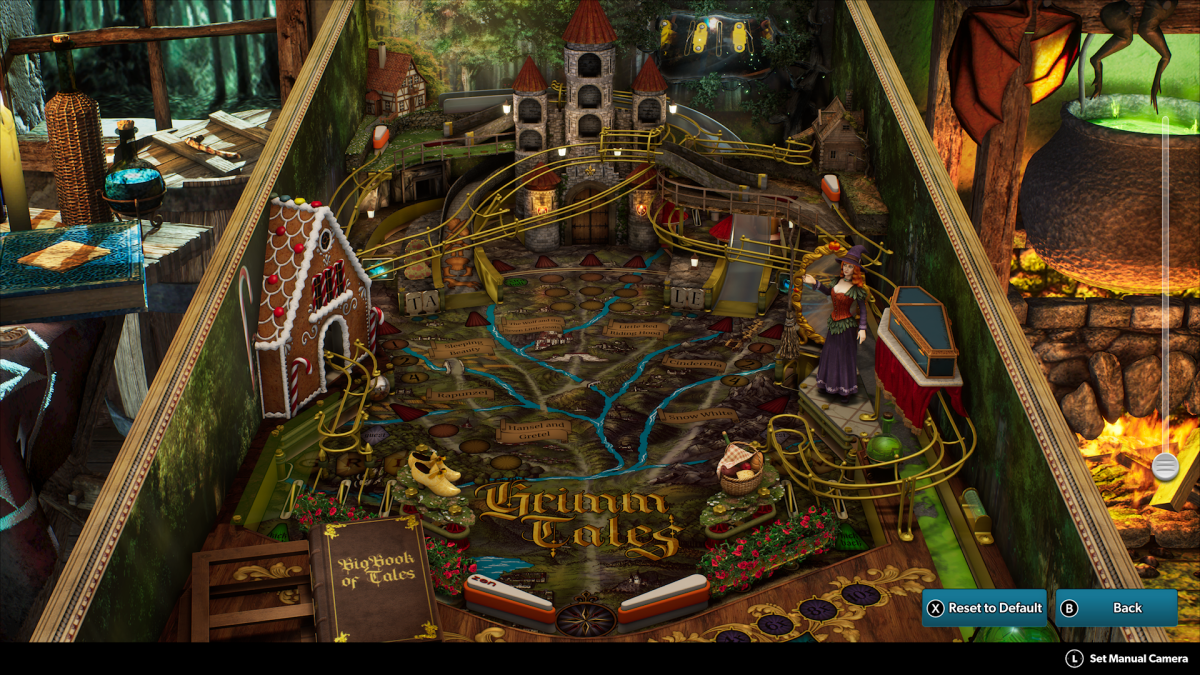
Grimm Tales First Released February 16, 2023 Main Platform: Pinball FX Switch Platform: NOT RELEASED ON SWITCH Designed by Zoltan ’Pazo’ Pataki Stand Alone Release ($4.99)
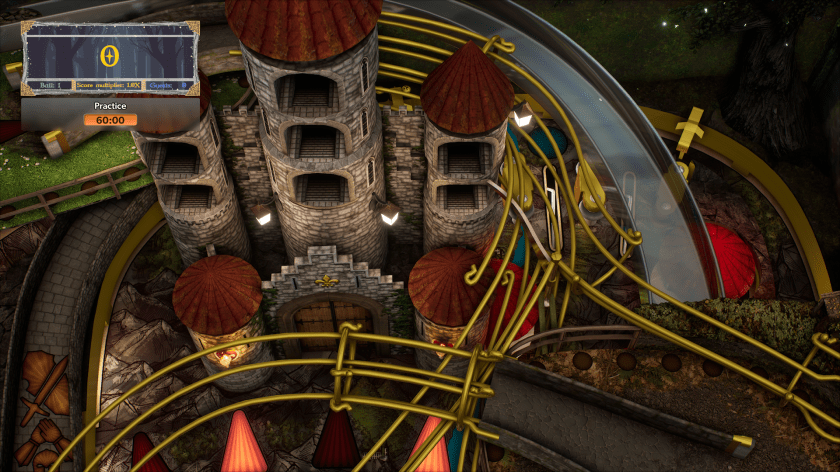
Okay, so using a gigantic castle placed in the center of a table isn’t exactly original. But don’t mistake this as a Medieval Madness wannabe. This is a fantastic original table.
Think of Grimm as being the unholy offspring of Medieval Madness and Tales of the Arabian Nights. The layout borrows heavily from Medieval Madness, maybe a little too closely. Oscar really thought it was just a touch too derivative, and not just because of the castle. Both the left and right long orbits feel very close to MM’s side shots and are such a cinch to shoot and spoon-feed the bumpers that tying a multiball just to them he thinks might have been foolish. I don’t disagree with him about the layout, either, but there’s plenty of effort to make it feel different as well. The ultra-steep damsel ramp has no evil twin in Grimm Tales. Instead, the game utilizes two very tough but fairly well-done toe shots for the gingerbread house (which lights modes) and Magic Mirror. The castle includes new angles as well, including a deceptively tricky “sneak around the back” shot that’s actually the REAL driver of the table, acting as both the mode start and extra ball shot. This is a table that has a lot of very fun shots, and while the ramps share similar placement as Madness, they don’t feel like the ramps on that table. The flow load is completely different.
Signature Shots – The Castle: Grimm Tales’ castle is four shots in one. The table’s driver is in a tiny orbit just left of the castle, and is also the extra ball shot. The gate switches which mode is lit and is always the final shot to end any mode. The two gatehouses act as ball locks for Crystal Multiball and might be too easy to hit, but there’s an inspired twist to that. The locks are still active when you actually start the multiball, and NOT locking a ball doubles the value of jackpots, adding a layer to ball management that we all thought was very clever. That was the part that sealed Sasha’s MASTERPIECEvote when she couldn’t decide which way she was going.One of the “ANGRY MODE” effects. You’re lucky if you get this one.
The Tales of the Arabian Nights DNA is in the modes. Each mode is based on a fairy tale instead of an Arabian Night, but they’re all relatively short. So short that it’s kind of surprising for a Zen table. Plus, most of the modes are actually a lot of fun. The problem is not every angle is. The “grandmother’s house” bat flipper pathways are maddening to shoot (see the caption below), and the Snow White mode uses the bumpers, which are overvalued in a table with THIS easy of access to them. The easiest extra ball to light is done by juicing the end of ball bonus to past 10x. In our duel, not a single Vice missed that EB in any game. Otherwise, the modes are punchy and rewarding, along with a pair of multiballs that are quick to activate and can be used to finish the modes. I also like the concept of being able to charge-up the table’s score via T-A-L-E lights, which could potentially multiply your score by 2.4x the playfield values. Not after the ball, mind you. DURING PLAY! That’s bold.
Signature Mode – Little Red Riding Hood: as unlikely as it seems, this short little shot is the hardest in the game. Nobody could get a feel for it, but if you’re going to miss, miss late instead of early. Just under the path is a hidden Ritchie Loop that gives you another crack at the shot. Neat. Not neat, and in fact one of the most annoying features on the table, is that in the Little Red Riding Hood mode, the ball is held over the flipper for far too long. “Slow pitch softball” is what Oscar called it, and he HATED it. Cussed a blue streak every time. Angela said “I’m never teasing the dogs by holding the ball too long when we play fetch ever again.” None of us hated the shots. On their own, as part of the Crystal Multiball? They’re fine. Tough, but we like tough. The delay before serving the ball in the Red Riding Hood mode? Well, it didn’t cause Dad or me to drop our score by itself, but we were certainly thinking about it when we voted GREATinstead of MASTERPIECE. It’s so bad that it feels almost like a glitch left in the game. It happens on the lower shot too.
VUKs that aim for the tip of the flippers? Not so much bold as it is annoying, but at least the physics are good enough to be able to clock the throw and take control of the ball. Actually, this is one of the rare Pinball FX tables that doesn’t feel like it’s specifically trying to prevent ball control, which is why I think the Vices all liked it so much. I’d even say Grimm would make a great trainer table, except one thing: the table seemingly randomly enters “Angry Mode” that screws with the physics or visibility of the ball. One of the “curses” is having a very strong wind push the ball to the left. I’m almost never a fan of screwing with live balls using video game physics. There’s also a witch who flies over the playfield during multiball modes and it’s so distracting. Don’t let any of that turn you off of trying Grimm, though. It’s one of the best stand alone pins you can get for FX and easily worth the $4.99 asking price. There’s a LOT to like about this table, and for some of us, it does enough to reach elite status.
For me, it’s GREATbut just short of the upper echelon. Jordi and Dash were frustrated by the stop-and-go nature of the table and the distracting ANGRY MODE and photo-bombing witch, which are also the reasons I didn’t vote MASTERPIECE. Oscar didn’t because he thought it didn’t have any stand-out shots. It was two kids who really loved it, (but don’t mistake this for a kids table, as both Angela and Sasha are highly skilled pinballers). Sasha was just barely MASTERPIECE, almost agreeing with Oscar that the lack of transcendent shots hurt, but the shot selection and heavy emphasis on flexible strategy won her over. Meanwhile, Angela said Grimm Tales was second only to Battle of Mimban as her favorite Zen original. “Maybe there’s more balanced tables or tables with better shots, but Grimm is just fun. It’s everything I love about pinball and isn’t afraid to be silly. Originally I felt bad giving it MASTERPIECE, but if I had more fun with it than some tables where I did vote that way, why can’t I? It does offer everything pros love, too. Maybe not as well as other top tier pins, fine, so don’t play it for flow. Don’t play it as a test of your skills either, even though it offers that as well. Play it to remind you that pinball is a game and games are supposed to be fun!” Cathy: GREAT (4 out of 5)
Sasha the Kid: MASTERPIECE (5 out of 5) Angela: MASTERPIECE Oscar: GREAT Jordi: GOOD (3 out of 5) Dash: GOOD Matthew: GOOD Scoring Average: 3.85
Scoring Average: 3.8 📜CERTIFIED EXCELLENT📜
Dr. Dude and His Excellent Ray First Released August 29, 1990 Zen Build Released October 20, 2020
Main Platform: Pinball FX Designed by Dennis Nordman Conversion by Zoltan Vari Set: Williams Pinball Collection 2 ($23.99)
Links: Internet Pinball Database Listing – Strategy Guide – Pinball FX Wiki
Sasha looked at me like my head was on backwards when she found out I rated the Pinball Arcade version “MASTERPIECE.” I’m not doing a bit here for comedy. She thought we were kidding. “THIS table? Dr. Dude? You think THIS is a top tier table? Maybe it’s better when the physics don’t kick the ball out of the Mix Master after a couple bumps, but even then, a MASTERPIECEshould be reserved for a table with flexible strategies. Dr. Dude doesn’t have that except for the order you check off the three main shots to light the mix master. The shots are fun, so I could see going GREAT, but this isn’t a MASTERPIECE, ever.” Everyone else and Dave backed her up. You’re all wrong and I’m right so pooey to you.
Much like the Pinball FX 3 version, Dr. Dude still features a ball that could go straight down the drain off a plunge. No ball save. The awesome series of sequence shots is hard to appreciate when you don’t even get a swing at the ball. It’s why Dr. Dude and his Excellent Ray is one of the few Pinball FX tables where I still prefer the now decade-old Pinball Arcade release. It’s just more forgiving, with a nudge that’s much better at defending against this type of thing. This isn’t a table for the faint of heart, with brutal difficulty and hair-raising angles. Oh, and the Dude-o-Meter doesn’t carry over between games, so you can’t even hit the Gazillion Point Shot unless you start the multiball five times in one game, an especially tough task for a table this heartless, with a key shot (the Magnetic Personality) that isn’t easy to lock onto.
Having recently played a real Dr. Dude AND the Pinball Arcade version, I was reminded of how fun Dr. Dude can be. It’s one of my favorite underrated tables. But on Pinball FX, the Mix Master is significantly less likely to hold a ball. A reminder that, as much as we admire Zen Studios, the engine for Pinball FX is lousy. Sorry, it just is. Real tables do not behave this way, and it wasn’t rare to have the ball pass through it doing only a single bump per shot. The physics are just too heavy whether you play classic, pro, or arcade.
The good news is Dr. Dude still has one of the best “awesome shot” to “meh shot” ratios of any alpha-numeric table. Nobody can ever accuse it of being boring. The key shots that actually matter are too exciting for that. Do you know what Dr. Dude reminds me of? An old, dependable car that puts up a fight when you turn on the ignition. The tricky part is just getting it started. Once you do, you know it’ll get you where you need to be. Once you find your rhythm in Dr. Dude, you’re in for one of the most satisfying pins of the late alpha-numeric era, where every shot, and even the act of trapping the ball, is rewarding. Despite being one of the few times Zen didn’t handily defeat the efforts of Farsight doesn’t matter all that much. Dr. Dude is still really good. We’re giving it an award and everything! But it’s a table I’m willing to rate MASTERPIECEand accept all the eye rolls in the world for, and I can’t for this build. It’s just not the best digital build modern gaming technology can do. Or 2010’s technology, for that matter. Cathy: GREAT (4 out of 5)
Sasha the Kid: GOOD (3 out of 5) Angela: GOOD Oscar: GREAT
Jordi: GREAT Dash: GREAT
Dave: GOOD (Played on Nintendo Switch)
Elias: GOOD (Played on Nintendo Switch)
Primary Scoring Average: 3.66 CERTIFIED EXCELLENT
Nintendo Switch Average: 3.5 🧹CLEAN SCORECARD🧹
Some review copies were provided in this review, others were paid for.
Special Note: Originally all Pinball FX tables were going to be posted to a single review guide, but there would have been loading issues. I’m splitting the guide into individual table posts.
Adventure Land
First Released December 12, 2017 Main Platform: Pinball FX Switch Platform: Pinball FX 3 Designed by Tamas “Ypok” Pokrocz Set: Zen Original Collection 1 ($15.99)
Links: Strategy Guide – Pinball FX Wiki
It’s a beautiful, zany-looking table, but the grinding combined with the hungry outlanes makes this significantly less fun than I think the average player would be primed for on looks alone.
Angela is beside herself that my father and I ranked Adventure Land GOODand claims our love of theme parks and their artificial reality is what distracts us from a table that flows badly. When she found out Jordi was giving it a GREAT, we had to fetch her fainting couch. Maybe she has a point, and in fairness to her outrage, this is as generic as an amusement park gets in media. I get why people would dislike Adventure Land. It features some stunning scoring imbalance issues and absolutely maddening slingshots and outlanes. Fine. She’s right in that regard, and I’ll throw in that Adventure Land has the absolute worst skillshot in all of Pinball FX. It’s above the right slingshot at a horrendous, high-risk angle that doesn’t seem compatible with the physics. The only time we’ve made it on Pinball FX 4 is via a lucky bounce. Making it opens the super skillshot, where you can light an extra ball, and it’s actually not even worth trying for that. The rest of the table is a massive grind, because that’s Zen’s thing. Adventure Land is the definitive burst-scoring table thanks to some of the most slow-to-active modes in Pinball FX.
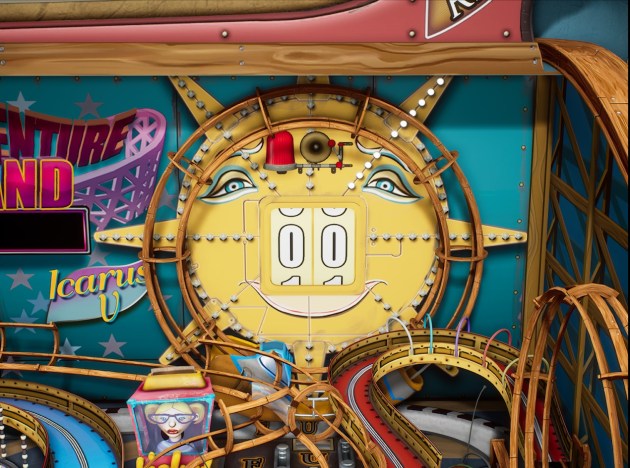
Persistent Problem – Mini-Game Rules: Mini-Games in pinball should be simple enough to be self-explanatory, but when that’s not the case, it drags the whole table down. Take the Icarus V here. It’s a minigame where you have to make a Ring of Fire-like ride do loops. And these are the instructions for the mini-game in their entirety: “Once the ball is inside the toy, press the flippers at the right time to make a loop.” That’s about as useless as giving a dog a tuba. What flippers? Both? Alternating? When’s the right time? There’s a bunch of lights. Which light is the one that signals “the right time?” Say what you will about Pinball Arcade and its hundreds of pages of painfully detailed instructions, but at least every question was answered. For Pinball FX, you have to track down what the actual object is on websites or the strategy guide. They need to hire someone to do better instructions. It’s arguable the worst overall aspect of Pinball FX and Pinball M are the instructions themselves. This is why we tend to prize intuitive tables and mini-games above all else. If they insist on complicating these things, practice mode isn’t enough because you still have to grind to get the shot, and then if you fail it in five seconds (like we used to do with Icarus V), you have to start the grind all over. They could fix this by allowing players to practice the more abstract mini-games separately.
Here’s the thing: Adventure Land’s layout is really good. Most of the shots are fun in a vacuum. The reason why I’m settling on GOODinstead of a higher score is Adventure Land’s good shots are rendered meandering thanks to the grind. The table is too big, the shots too spread out, and the time limits are too strict (even with shots that extend the timer) for Adventure Land’s own good. This is one of those pins that’s BEGGING to be saved with a ROM update that cuts the grind and shot requirements. Maybe all of that wouldn’t be a problem, but Adventure Land wants to be both a grind-a-thon AND a brutally punishing table with serial killer outlanes and slingshots. It takes too long for this table to feel rewarding. Too repetitive. Too back-loaded. I like shooting on Adventure Land, but when it takes forever for those shots to pay off, it’s a downer. It’s a slog. And, for a lot of players, it’s a big turn-off. I’m also not a huge fan of the mini-games that act as a buffer because, on a table that shoots this tough, they make it harder to get into a rhythm. Adventure Land is one of those pins that’s showing its age a lot sooner than a lot of much older Zen originals. There’s a chance in another two to three years, I’ll be dropping my rating to BADas well. Cathy: GOOD (3 out of 5) Angela: BAD (2 out of 5) Oscar: GOOD Jordi: GREAT (4 out of 5) Dash: GOOD Sasha: BAD Elias: BAD (Pinball FX3 on Nintendo Switch) Overall Scoring Average: 2.71* –GOOD
Primary Scoring Average: 2.83 – GOOD
*Nintendo Switch version is, more or less, identical to all other versions.
Some review copies were provided in this review, others were paid for.
Special Note: Originally all Pinball FX tables were going to be posted to a single review guide, but there would have been loading issues. I’m splitting the guide into individual table posts.
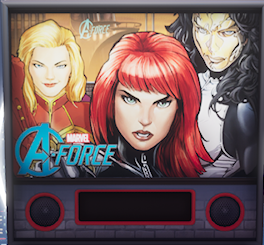
A-Force aka Marvel’s Women of Power: A-Force
First Released September 27, 2016 Main Platform: Pinball FX Switch Platform: Not Yet Released Designed by Thomas Crofts Set: Marvel Pinball Collection 2 ($29.99)
Links: Strategy Guide – Pinball FX Wiki
Kickback – Angela: I’m in disagreement over how well four out of five modes in A-Force are. They’re modes! You aim at the targets it tells you to shoot and you shoot, no different from any other table. Yes, the lights are badly done and too many that aren’t tied to modes blink at once, but that just slows down how fast you learn a table. It doesn’t affect the quality of those shots. Plus, you don’t even have to win the modes to make progress, which is something my family claims they want from Zen. Frankly, I don’t know what more they could have done that would win everyone over short of removing the timer for them. They even stack with mini-modes to add additional excitement. Maybe they’re a little repetitive, but the shot selection is different for each and they don’t feel much alike. I think A-Force is one of Zen’s best pins, Marvel or otherwise.
The smooth-shooting A-Force is one of the most underrated Zen original creations, and in Pinball FX, it seems the difficulty has even been slightly scaled back. Maybe it’s the placebo effect since it’s subtle, but the rails no longer feel like they spoon-feed the outlanes. The result is a table up for players of all skill levels. What I really love about A-Force is that the act of learning the table’s flow and which shots work in combination with each-other is as exciting as making the shots too. It’s a complicated layout, but not in an overwhelming way, and that “ta-da” moment when you put it together is so satisfying. Awesome shot selection too, and oddly enough, the gigantic Titanium Man head that sticks out in the most smackable way isn’t the key to it all, but let’s talk about him. He’s tied to a multiball mode, his own mode (the 5th mode, specifically) which is also a multiball mode, and to a hurry-up that yields a lot of points. Clearly Thomas Crofts understood how fun this target was.
Signature Mode – Restore the Reality: A-Force’s wizard mode is a timed multiball rush with a twist: instead of flipping flippers, you create a series of explosions at the flippers that launch the pulsating red balls at the orbits. It’s silly but a lot of fun.
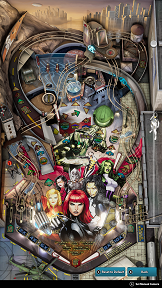
What ultimately keeps A-Force out of the Pantheon are the modes. Only the two-ball battle against Titanium Man stands out, and maybe a mode where a helicopter drops bombs on the city that you have to shoot to collect. The remaining three are somewhat bland and uninspired, but at least you don’t need to shoot perfectly or even win in order to get the checkmark for them. This is the way Zen should do every table: if you fail, the mode is still checked-off, and then after you’ve played the wizard mode, the second cycle changes the rules and you must win a mode in order to check it off. I love that. Zen could probably bump the ratings of 20% of their pins by updating their rules for that. With that said, although the final Wizard Mode succeeds in being a visually-striking tribute to late Williams arcade-era final multiball showdowns, getting there is a bit underwhelming. I don’t agree with Angela’s “modes are modes” belief, because I think it matters that it’s often not clear what shots are for what mode. It doesn’t do a good enough job of directing you towards the prudent shots. And while I’m on the subject, I can’t imagine playing this without the vertical table-view, since the playfield is massive but obstructive. I really wanted to make the leap and declare A-Force a masterpiece, because I think it has to be in the discussion for best layout in the entire Marvel brand, but I couldn’t quite work myself up enough to do it. The layout was worthy, but I don’t feel they used it to its fullest potential. Cathy: GREAT (4 out of 5) Angela: MASTERPIECE (5 out of 5) Oscar: GREAT Jordi: GREAT
Sasha: GREAT
Overall Scoring Average: 4.2📜CERTIFIED EXCELLENT📜
Some review copies were provided in this review, others were paid for.
The Addams Family
First Released March, 1992
Zen Build Released February 16, 2023 Main Platform: Pinball FX Switch Platform: Pinball FX Coin-Op Designed by Pat Lawlor Conversion by Zoltan ’Pazo’ Pataki Stand Alone Release ($9.99)
Make sure to read the entire review for a special note on the Nintendo Switch port.
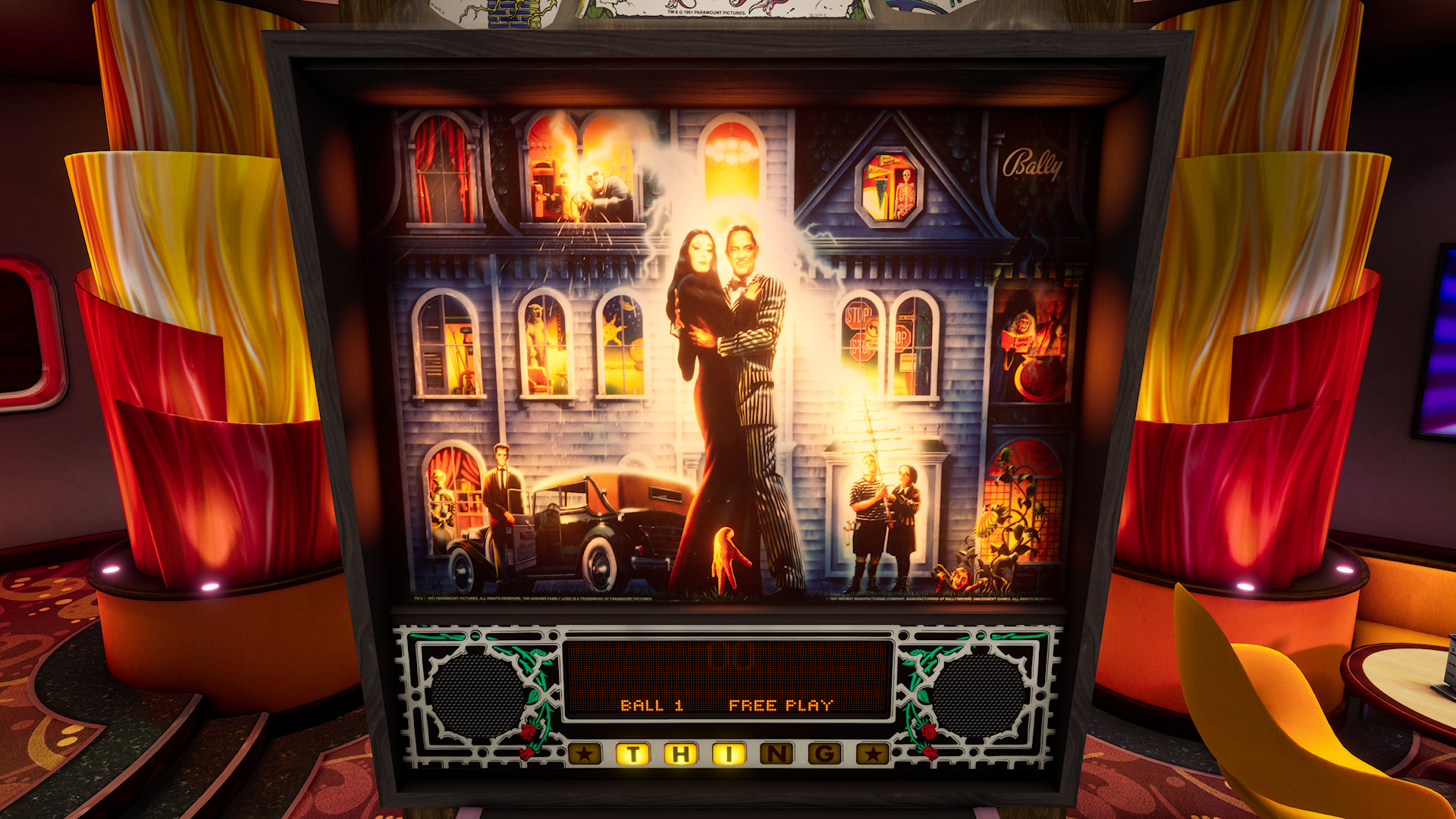
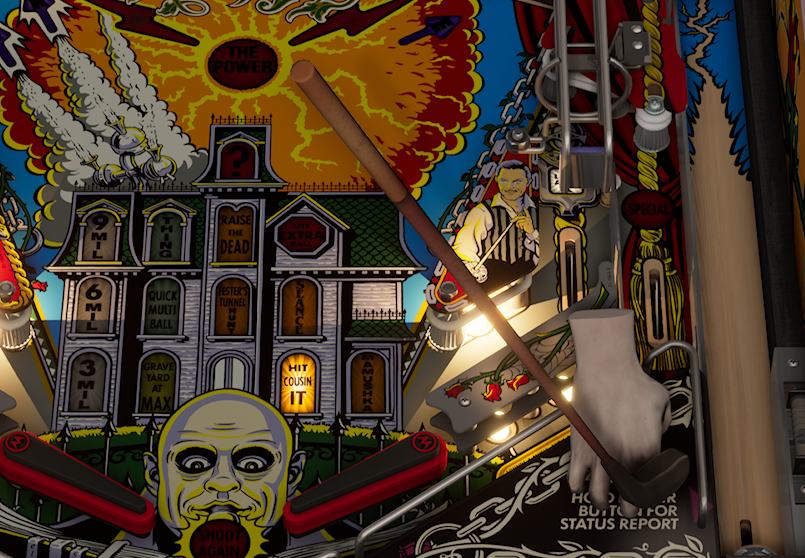
I’ve almost run out of things to say about Addams Family. It’s the biggest seller of all-time and the dream table of most novice pinball collectors. What I find fascinating is all of these accolades and achievements are earned despite Addams Family being, frankly, one of the most unfair pinball machines of the 1990s. There are so many ways where the table’s mechanics can override perfect play and still kill you, and this on a table already crowded in a way that’s tailor-made to punish you for bricks. Specifically, it’s those damn magnets that push the ball down the drain or an outlane. We’ve all experienced the pleasure of starting the Seance and having the magnet immediately guide the ball straight down the drain a half-second into the mode. Seriously, Seance is the most maddening mode in the history of pinball. Pat Lawlor could have built a compressed airbag that blows up in the player’s face, and that act wouldn’t make him as big a jerk as Seance does.
Addams has two historically amazing ramps. So satisfying to hit, especially the side one. The little twist it does at the end is so delightful.
And of course, when the Thing Flip bricks so badly you die from it? That’s one of those moments where taking a sledgehammer to a $10,000 pinball machine becomes oddly tempting. So, why is this table beloved? Perhaps it’s because Addams Family integrates its theme better than any pinball table of the arcade era, producing exactly the type of pinball-based gameplay that celebrates a macabre family who doesn’t follow society’s rules. It’s not fair, but it doesn’t pretend to be, either. It revels its unfairness with a wink and a hug that’s endearing, even if the table is plunging a knife in your back as you embrace it. I can’t say enough about Raul Julia’s historically amazing call-outs. Sometimes real life movie stars phone-in their pinball voice work. Not Julia. He belts his call-outs with gusto. Cheers to the great Raul Julia, performer of the greatest pinball voice over in history! 🍻
How fun it must be to get the “remove Christopher Lloyd from the art” assignment.
Zen’s take on Addams is an imperfect port. Yes, Thing Flips misses on a real table, but, it’s a woefully bad shot in Pinball FX. Oddly, the first few builds of Addams on PRO difficulty had the ball moving so fast that Thing Flips didn’t even work in that setting. Now, it not only works, but the PRO difficulty is the best-shooting Thing Flips in all of Zen’s builds. All other variations? If this were the NBA, Zen’s Addams is the table you want to foul in a close game with only seconds on the clock, because that auto-shot is a bricklayer. The magnets for the start of the Seance or when you’ve lit multiball are also much more lethal on Pinball FX than they are in real life, with about a quarter of our games being an instant kill when the magnets carry the ball from the VUK to the drain in literally less than a second. Many purists would have it no other way, but part of me wishes Zen would create a second, idealized version of Addams that isn’t engineered like a cabinet that has to earn a living two quarters at a time.
No judgment if you want to play with the enhanced graphics on. But, you should know that you have to wait for the graphics to tee-up the pinball, which actually makes a difference in the five minute mode.
One last note on the Thing Flips shot: in a real life table, when you or the auto-shot misses the cross-table Swamp shot, it’s fairly common for the ball to ricochet in a way where you get a second chance to convert the shot. That almost never happens in the Zen Studios build. In my opinion, Pinball FX in general doesn’t have enough PING off solid surfaces. You can tell that their engine is built for their original works more than for the Williams/Bally pins because ricochets and rebounding matter a lot less in their newly-created tables, most of which aren’t defensive-minded. Coin-op pinball during the 80s and 90s, by its very “earning quarters, one player at a time” nature, requires pinball to be played defensively, with a heavy emphasis on rebounding and conversion shots. It speaks volumes to how strong Addams Family is as a table that I’m still going MASTERPIECE, even though I prefer the Arcooda build.
This slideshow requires JavaScript.
The gap is closer than ever before, and if Zen Studios can improve their physics, especially their problems with balls going limp when they should be ricocheting, they move head-and-shoulders above Arcooda. For now, Arcooda’s Addams is #1, by a slim margin. Of course, that’s a minimum $150 buy AND you must already own the tables on Pinball Arcade. Otherwise, it’s a $500 buy-in (and it requires two monitors) for a marginal upgrade. Or, maybe it’s not so small of a margin. One thing that bugs the hell out of me about Zen Studios is their refusal to include the options real tables have. I’ll get into that more in Vice Versus underneath the body of this review, but I’ll take this moment to note that Williams/Bally tables were loaded with fun options, and Pinball FX offers exactly none of it outside the “pro” difficulty, where the slope of the table is increased, the outlanes are widened, and the table’s internal toggles are set to “extra hard.” That isn’t very fun because of the steeper slope. I wouldn’t even mention this stuff except I know these guys making these tables and I know they’re better than no options at all.
This slideshow requires JavaScript.
On Nintendo Switch Addams has a fairly significant problem, albeit one that I am HOPING to delete (along with this entire section) later this Summer. If you take a dead flip from the Electric Chair, the ball will bounce across from the left flipper to the right flipper, then roll-up the right inlane’s switch, activating the temporary light of the electric chair, which you can then reshoot. This almost never happens on the coin-op. If your aim is true, you can use this to quickly run through the different modes and reach TOUR THE MANSION in record time. Now granted, you won’t be scoring as many points as you’d think if you begin this cycle right off the bat, since if you cheese the game, you’re not scoring points on Cousin It, Raise the Dead, Thing Multiball, and the Mamushka. But you can start cheesing the table at any time, making the final push towards TOUR THE MANSION trivial. For this reason, everyone but Elias discussed this and we decided to drop our ratings by one rank on Switch until this is fixed.
This slideshow requires JavaScript.
NINTENDO SWITCH UPDATE: The Big Update everyone’s been waiting for has dropped on Nintendo Switch, and with that, an improved Addams experience. Thing Flips are much more accurate, and manually shooting is much easier. Since Angela’s strategy is to charge-up the value of the Swamp Shot and tee it up till her heart’s content, she appreciates the much more true-to-life angles. The magnets are also much more accurate than they were before. Unfortunately, it’s still too easy to use the electric chair exploit mentioned above. For that reason, Angela, Oscar, and Dave have decided to keep their Switch scores in place. I’m not. I think that if a person wants to burn through the doors without utilizing their value, that’s on them. It’s a risk/reward calculation that makes sense. True to life? Not in the case of the electric chair’s drop. Everything else? This is a much improved experience. Make sure to read our Addams Family on Switch feature, which also includes a look at the ultra-rare (delisted in under two hours) Pinball Arcade version of Addams on Switch! Cathy: MASTERPIECE Angela: MASTERPIECE – GREAT on Nintendo Switch Oscar: GREAT – GOOD on Nintendo Switch Jordi: MASTERPIECE Dash: GOOD
Dave: MASTERPIECE – GREAT on Nintendo Switch
Elias: GREAT – Played on Nintendo Switch
Sasha: MASTERPIECE – GREAT on Nintendo Switch
Standard Pinball FX Scoring Average: 4.5 – GREAT
Nintendo Switch Scoring Average: 4.0 – GREAT 📜Awarded a Certificate of Excellence📜
VICE VERSUS
The electric chair is one of pinball’s all-time great drivers.
Addams Family makes for a great competitive table, which is why we’re so disheartened that hot seat’s modes don’t allow for scores to the online leaderboard, when there’s no real competitive advantage for using hot seat mode. It’s also frustrating that there’s no options beyond the seven main gameplay modes. We like to play “Galactic Rules” which is 10 Balls + 10 Potential Extra Balls, or “Iron Ball” which is 10 Balls, no Extra Balls, and we’ll tinker with the rules like extending the hurry-up time, or the ball save time, etc. We’re certainly not arguing those should count towards online leaderboards, but we’d have a LOT more fun with Pinball FX if not for the lack of options. This ability was up-sold on Pinball Arcade as the “Pro Mode” which, if Zen were to do that, yea, we’d pay for the upgrade. Zen wastes too much time on fancy “enhanced” graphics when the best upgrades are right there, built into the pinball’s software itself. Still, Addams is one table we never get sick of competing against each-other in my house.
GAME ONE – CLASSIC
Sasha: 157,922,100
Cathy: 217,160,880 – Toured
Angela: 169,511,430
Oscar: 208,727,270 WINNER: Cathy (1)
GAME TWO – PRO
Cathy: 60,519,390
Angela: 114,712,130 (24th All-Time)
Oscar: 50,239,100
Sasha: 56,579,540 WINNER: Angela (1)
GAME THREE – ARCADE
Angela: 236,139,300 – Toured
Oscar: 242,113,290 – Toured
Sasha: 190,444,270
Cathy: 162,871,540 WINNER: Oscar (1)
GAME FIVE – ONE BALL CHALLENGE
Sasha: 50,543,940
Cathy: 87,197,950 (#22 All-Time)
Angela: 87,779,430 (#21 All-Time)
Oscar: 41,610,620 WINNER: Angela (2)
GAME SIX – FIVE MINUTE TIME CHALLENGE
Cathy: 115,861,870
Angela: 102,849,350
Oscar: 146,568,420 – Toured (#15 All-Time)
Sasha: 112,528,890 WINNER: Oscar (2)
 Grimm Tales

 Cathy: GREAT (4 out of 5)
 Dr. Dude and His Excellent Ray

 Cathy:
  CERTIFIED EXCELLENT
 Adventure Land
 Cathy:
  A-Force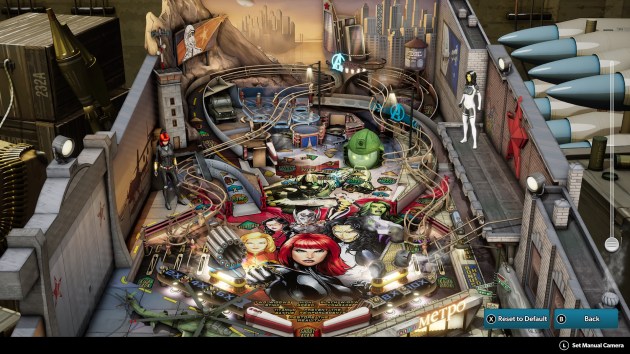

 Cathy:




 The Pinball Chick
You must be logged in to post a comment.