
Indiana Jones. I always knew some day you’d become part of Zen’s lineup. I never doubted that. Something made it inevitable. So, what are you doing here in Pinball FX3?

I learned to hate you over the last two weeks! Those damn house balls. That maddening capture ball lane. That succubus you call a left outlane. Pinball fans have waited for Indiana Jones: The Pinball Adventure to come home in an official capacity for almost thirty years. I think that has a lot to do with the table practically having an out-of-order sign tattooed on it. It’s a machine infamous for having issues and being unsuitable for routing in locations without a technician on stand-by. It’s a member of the SuperPin line, but it doesn’t feel like it. Some of the concept was done in part by Brian Eddy, but it doesn’t feel like it. Like Twilight Zone before it, you go into Indiana Jones aware that, no matter how much fun you have, it was a doom harbinger for the sport itself. The final table to join the 12K Club, and the second-to-last table to clear 10,000 units sold (Star Trek: The Next Generation was the last to do so). Of course, that’s purely on technical failings that have nothing to do with digital pinball. The Pinball Chick Team universally enjoyed the table, to varying degrees, and we all had different thoughts on it.
Made of Stern-er Stuff
by Angela D. Vice
 Of the twenty-two conversions of real tables Zen has done, Indiana Jones: The Pinball Adventure is the most modern-feeling. Or, at the very least, tied for first with Theatre of Magic. There’s twelve modes, but really, there’s nine shots you need to commit to memory for those modes.
- The mode start, which also adds a small bonus to every mode and caps off the Streets of Cairo with a 20,000,000 bonus (or you can fire the plunger button to end the mode at any time with a 2,000,000 point bonus).
- The left and right loops, which are used in Streets of Cairo, Monkey Brains, and Tank Chase.
- The left and right ramps, which are used in Streets of Cairo, Monkey Brains, and Survive the Rope Bridge, along with Steal the Stones and Three Challenges being tied to the right ramp and Path of Adventure mini-table.
- The three center stand-up targets, which are used in Get the Idol and Well of Souls.
- The capture ball, which is used in Castle Grunewald (it’s supposed to be Castle Brunwald).
With an emphasis on the orbits and ramps, not to mention the heavy use of multiballs, you could mistake Indy for being a modern Stern table. Even the fan service aspect, with modes based on memorable scenes from original Indy trilogy and most of the call-outs being samples taken directly from those films, feels much more contemporary than any other table of the 1990s. Frankly, they didn’t make pins like this back then. It doesn’t feel anything like close cousins Addams Family or Twilight Zone, except maybe in the generous amount of extra ball opportunities. The Mark Ritchie-signature cross-ramps don’t feel anything like the ramps of Firepower II, Sorcerer, or Fish Tales. This is a table that should be a relic, yet instead plays like it came from an entirely different era.

Even more remarkable is the fact that every single mode is a true thrill to complete. I get tensed-up with excitement every time Raven’s Bar and Survive the Rope Bridge begin, knowing that I can score an extra ball if my accuracy is on point. Choose Wisely, a video mode variation on the shell game, is an easy 25,000,000 points for everyone but my unwise sister, while the Mine Cart game is one of the most inspired and fun video modes in all of pinball. Even the Path of Adventure mini-table gets in on the action, with two modes utilizing it. Did you previously light the Extra Ball or Pit holes before entering those modes? They’re still lit and waiting for you. The more modes you complete, the bigger your end-of-ball bonus. This is especially valuable using the double-the-points boost in standard mode. If the Pinball Chick team did a ranking of all twenty-two Williams tables by modes, Indy would be a unanimous #1. Of course, that’s assuming you actually get to play the modes with all the house balls this table vomits out.
If You Listen to Me More, You Live Longer
by Dash
Folks, this is a tough call for me. With Indiana Jones being indisputably the most expensive table they’ve released to date. Not TABLE PACK. Just “table” by itself. It’s natural to want to ask, why? The answer is simple. Licensing. A record-setting amount of royalty checks had to be cut to make this re-release a reality.
Now, with Zen tables there are two aspects to consider when it comes to “theme”. The first is the original table they are trying to reproduce and build upon. The second is all the extra bells, whistles, and polish that Zen themselves add to push the original over the top and give it their own “special something”. Let’s start with the tables original theme. The cabinet art is nothing fancy. A silhouette and the Indiana Jones text in proper font. The back-box and playfield sport artist renditions of key actors and locations from the only three Indiana Jones movies that have ever and will ever exist (at least in my mind). The rest is fairly generic jungle art which neither delights nor disappoints. Given how much ground they were trying to cover across three films it was probably their safest bet.

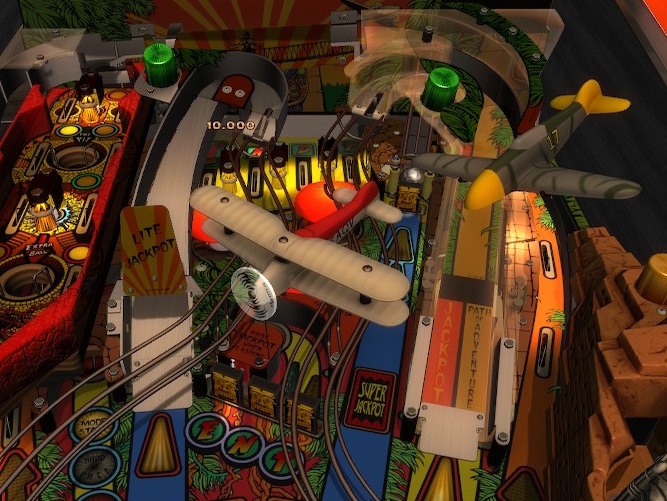
The original art package presents itself very well on my 40” 4k V-Pin screen. Crisp and clean likenesses of Sean Connery, Harrison Ford, Karen Allen, John Rhys-Davies, Ke Huy Quan, and Kate Capshaw all make prominent appearances in call-outs, DMD animations, playfield artwork, and the backglass. I do wish there were a few more call-outs as the ones included repeat a lot. That said, somehow hearing “You cheat Dr Jones!” (spoken whenever you lock a ball for multiball without fully opening the lock) and “You sure know how to show a lady a good time!” never get old. In the way of toys there are a couple of large planes, a rotating “golden monument” which houses and deploys captive balls and a tipsy turvy mini-playfield. There are three video modes which fit the theme. Especially “Choose Wisely” which has you picking the right chalice from a mixed-up lineup.
Then there is the launcher. Here, like on the real table, it’s a button style auto-launcher that takes the form of a nifty Pistol. On the real table, it’s kinda cool. With every launch, I think back to that epic scene where Indy brings his gun to a sword fight, ending it quickly and comically (a result of Harrison Ford needing to go potty really badly). With time and experience, however, it’s come to fill me with dread because the fixed strength launcher means no way to fine tune your launches to compensate for the dreaded and all too frequent “launch, bumper, straight down the middle” house balls that others have mentioned. On the real table the tradeoff was understandable. For a brief moment standing there, you vs the table, you get to feel like Indiana Jones. Here in digital pinball land, though, you don’t really see that launcher during play. Even when you do see it. It doesn’t pull you in and connect you to the table in the same way and all the house balls it leads to make it more trouble than it’s worth. This table feels like it really should have had a plunger. They chose… poorly.
Alright, so other than the launcher, all good on the theme right? I wish I could stop right here and say “yes.” But remember… Zen doesn’t just stop with a faithful reproduction of the original, they also add their own flair and this, for me, is where the proverbial minecart goes off the rails.
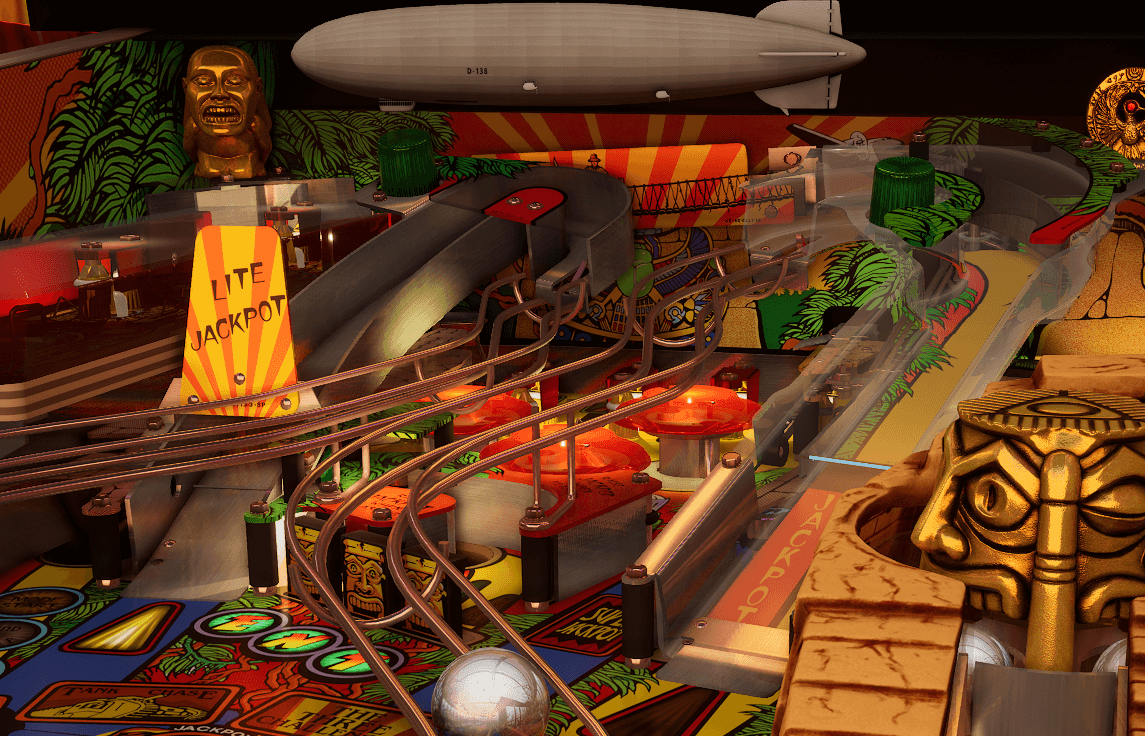
First the good stuff. Zen has added a zeppelin toy to the upper playfield. Nice. They also added a tank and the Ark of the Covenant on the apron which both have some simple animations tied to related modes in the game. On the playfield the main Indy art between the flippers switches during some modes to show animated sequences in line with the movie events the mode is based on. Very nice.
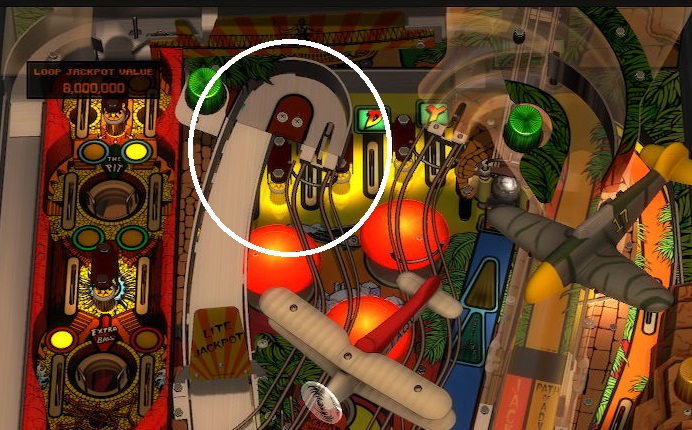
Then… there is the animated Indian Jones himself armed with his trusty whip. He whips and swings around the table constantly. It’s usually not too distracting. That said, he’s rather large and crosses the playfield several times each game. So it’s only a matter of time before you lose a ball or two due to him obstructing your view of the playfield as he swings over the playfield during an active ball! He’s like a bad penny, he always turns up and sometimes he costs you a ball. There is also a rain effect that kicks in during the Castle Grunwald mode that doesn’t use any kind of transparency, so if you have a multiball going, good luck seeing through all the rain. This would be unforgivable if it was an easy table. But this is not an easy table. So extra flair that leads to more cheap drains is absolutely not welcome. Turn the extra flair off and you only have the normal house balls off the launch to worry about. It’s a shame to have to do because the rest of the flair Zen added is well appreciated.
House Balls. Very Dangerous. You Go first!
by Jordi
At first glance, the table seems almost extremely easy. There is a wide variety of modes and video modes, and even multiple multi-balls. It’s also very easy to find the mission start hole to actually play all of these. The video modes are especially easy. Raven’s bar is one which you can master and walk away with an extra ball each time. Mine Cart is quick memorization with a middle checkpoint, and Choose Wisely is not at all hard (tell that to Cathy!). In the Zen’s standard single player mode, you can even use the ball reverse power to cheat at the latter two! Then there’s the mini playfield tilt board, which is just perfect. Any mistake here is your own, and not a cheap loss (at least on standard physics. See the next picture’s caption). So all these combined should mean the table is easy and fun, right?

Unfortunately, there’s flaws. Every launched ball is at risk of going straight down the middle (STDM). They must have known this was an issue since ball saves are given at every launch and are easily earned, but still, when you start the multiball from the captive lock, you’re going to lose at least one ball with no fault of your own. The multiball which starts from the idol lock is unpredictable, sometimes balls leave so fast you have no time to react and catch them on the flipper before they drain, especially when other balls are already in play.
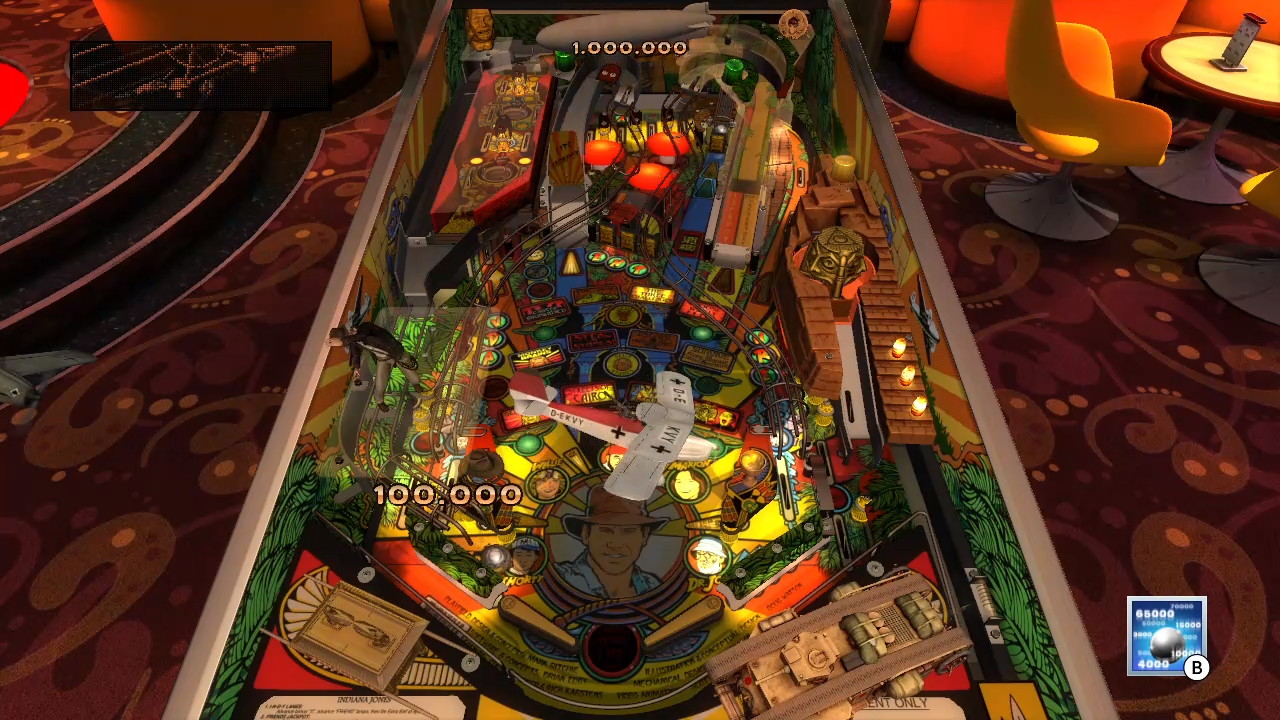
Then there is the left outlane. This is a wide body so you’d think balls wouldn’t go there all the time. But, once a gall goes for the left side you have to slam the nudge upwards or lose yet another ball. This is also a table where the Zen visual enhancements aren’t as well thought out. On some camera views, the Indiana puppet will obscure the ball as he swings about, and the air-fights that fly around in the dogfight will do as well. If you’re serious about playing a good round, turn those off! Overall, the difficulty in this table does not come from its modes, but from what I can only consider design flaws. The left outlane is badly designed and there should be a pin between the flippers to prevent cheap STDMs. This table could have been amazing but as it is, I am left wondering if the modes were made as easy as they are because the designers knew the cheap ball losses had to be compensated for.
WARTS AND ALL
by Dave Sanders
Mark Ritchie dislikes wide body games. The telltale sign is that Indiana Jones is a WINO. Don’t bother asking what the tipple of choice is; that’s my shorthand for Widebody in Name Only. Remove the idol and look underneath the (never bettered) tilting upper playfield, and what you’ll see underneath is a fairly conventional two-flipper standard body layout, with none of the shots really utilizing the additional space at the sides. Being a WINO does not automatically a bad game make, especially if you want to retain speed; the trick to a successful one is in disguising it with large diorama gimmicks or other places for the ball to go. Data East Guns N’ Roses is a WINO. My own Full Throttle is a WINO. But if Indiana Jones shoots like a standard, how does it retain the relative sluggishness associated with wide body games? And if you’re going to nickle-and-dime the arcade player after the wild excesses of Twilight Zone, can’t you be more subtle about it than with the bitchiest of bitchy left outlanes, and double-STDM house balls from the pop bumpers off the captive ball rubber?
And this is the core issue with Williams Indy. When it’s good, it’s very good indeed. But when it decides to be bad it’s awful. As a complete entity it balances out to so ‘basically OK’ that I can’t shift the ennui of not really wanting to stick it on again when there are some three or four designs of my own that I’d much rather be working on. And that’s not what you expect for a single $15 table, the $100,000 license (if the Farsight Kickstarters are any indication) be damned. (Cathy’s Note: We do not know the full license cost but I’m told it’s the most expensive the medium has ever done)
Granted, pinball collectors and tournament goers (the players most likely to pony up the asking price) are a more forgiving bunch than any casuals are going to be. But for a mass-market product that’s already put out the far superior (and cheaper) fan-shot triumvirate of Monster Bash, Medieval Madness and Attack From Mars, this is not a good look for Zen nor a welcome direction to be going down, even if Indy was guaranteed to sell bucketloads by (a) being so hotly anticipated, and (b) not being the Stern one.

Zen does have a ‘solution’ they could implement if they had a mind to, since the engine uses two distinctive sets of physics. If the flaws in this table are so damn obvious, then why not use the regular FX3 game to ‘fix’ them, and reserve the ‘classic’ physics for the way the machine was intended to be with all the niggling flaws still intact? Wouldn’t it please the larger proportion of a player base that you *should* be attracting? I mean, it’s not like a Dark Souls easy mode, it can’t possibly be that controversial to suggest, can it? At least think about it for when you get to Jack*Bot.
Uh-oh. If you’ll excuse me, either I’ve wandered into a Sega Frankenstein or that’s a rampaging mob of purists with pitchforks and torches about to storm my front door.
Ending and Beginning
by Cathy “Indie Gamer Chick” Vice
This is it. The last of Pinball FX3. It’s been a trip. The sad thing is, although Zen Studios gave us many excellent translations of all-time classics, they only did two tables that weren’t part of Pinball Arcade’s lineup, and this is 50% of them. The other, Space Station, was such a random choice that it’s still shocking, well over a year after it dropped. Indiana Jones isn’t that shocking. Zen works with Disney, who owns the Indiana Jones IP, and they’re made of pinball fans. This was their #1 wishlist table to convert. Of course, bringing Indiana Jones: The Pinball Adventure to their service required more royalty checks than just Disney. That’s how it ended up with a $14.99 price tag.

That’s a lot for a single pin, and especially for a pin that nobody would call an all-timer. Do you know the scene from Last Crusade where the Holy Grail is RIGHT THERE, and the Austrian chick falls to her death because she won’t give Indy her other hand? “I can reach it.. I can almost.. reach.. it..” That’s this pinball table, and instead of reaching for the Holy Grail, it’s reaching for historical excellence.. and it can’t.. quite.. reach.. it.
And, you know what? It’s not just the house balls. There’s something incredibly off at all times with Indiana Jones. This is a table with an identity crisis. You can choose your own strategy right out of plunger.. BUT, it’s not laid out like a pick ‘n flick. It’s a brick layer that demands precision, or else.. BUT, it’s not certainly not laid out like like a sharpshooter. It has some of the most violent slingshots and downright deadly outlane rails in the sport.. BUT, it’s not arranged like a kinetic. As Dave said, it’s a SuperPin, but not a traditional widebody layout. It feels like a table that wanted to be driven by modes, but had no plans beyond those.

It’s a miracle that what’s here is as fun as it is. In a table full of juxtapositions, the most fitting one of all is that Indiana Jones: The Pinball Adventure is unforgettable. There’s not a single shot I’d describe as “memorable”, with the possible exception of a lit Path to Adventure ramp (even that requires a large, tilting mini playfield to stand out). Instead, the magic comes from building up completed modes and inching closer to the incredible Eternal Life wizard mode. I don’t think Indiana Jones will become anyone’s go-to table that severs as a fitting swan song to Pinball FX3 and a launching point for the new Pinball FX. At least when it doesn’t instantly kill you.
SCORES (Highest and Lowest are crossed-out)
Cathy: GREAT
Angela: GREAT
Jordi: GREAT
Dash: GREAT
Oscar: GREAT
Dave: GOOD
THIS TABLE IS CERTIFIED EXCELLENT BY THE PINBALL CHICK TEAM

 The Pinball Chick
Quote from Jordi’s section: “The video modes are especially easy. Raven’s bar is one which you can master and walk away with an extra ball each time. Mine Cart is quick memorization with a middle checkpoint, and Choose Wisely is not at all hard.” Is this true, that the mine cart video mode is a set pattern like Star Trek: TNG’s simulation mode?!
I’m pretty sure it is, or a limited number of randomized full pathways. There’s an easter egg hidden in it where you can get the Warner Bros./Looney Tunes Dancing Frog (“HELLO MY BABY, HELLO MY HONEY, HELLO MY RAG TIME GAL”) and it requires that you take specific turns in specific order to get this. Logically, since the code to input it is the same, it means that the pathway to it can never be the dead ends. I believe there’s like 3 or 4 preset full circuit maps and it’s randomized which one you get. I’ve only completed the whole thing once. Angela has done it six or seven times. Ozzie the Great has never finished it and Sasha hasn’t really put quality time into it. It’s tough.